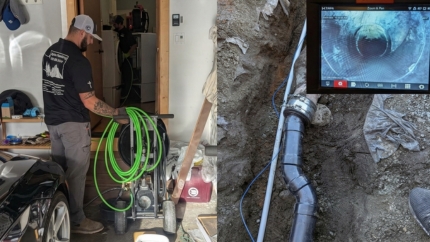
A slow drain rarely stays a slow drain. What starts as a minor inconvenience underground often signals a much larger issue building beneath the surface, one that won’t announce itself until a pipe has already cracked, collapsed, or backed up into your home. By the time raw sewage surfaces in a basement or yard, the damage is no longer preventable; it’s already happening. At Alpine Plumbing, our team relies on sewer line camera inspection technology to catch these problems while they’re still small enough to manage on your terms, not the pipe’s.
In this blog, we talk about how sewer camera inspections work, what you can see underground, and how they compare to the trial-and-error methods that plumbers used for decades. And you’ll learn what typically happens after an inspection and how to spot the warning signs most homeowners miss completely.
What Is a Sewer Line Camera Inspection?
A sewer line camera inspection uses a waterproof, high-resolution camera mounted on a flexible fiberglass rod, typically capable of reaching 200 to 300 feet into a pipe. As the cable advances, it transmits real-time footage to a monitor, giving a direct view of the pipe’s interior rather than a guess based on surface symptoms.
Many professional plumbers are grading what they see with the Pipeline Assessment Certification Program (PACP), an industry-standard scoring system created by NASSCO that rates pipe defects on a severity scale. This allows an inspection to not only show there is a problem, but to quantify how urgent that problem actually is, something a visual guess from a plumber standing at a cleanout could never do.
What Can a Sewer Camera Inspection Find?
Underground pipes fail for very different reasons depending on their age, material, and surrounding soil conditions. A camera shows which of these particular problems is actually at work.
1. Tree Root Intrusion
Roots do not need a large opening to get into a pipe; a hairline crack is enough of a gap. They multiply quickly inside, feeding on the moisture and nutrients in the line, and will continue to grow until the pipe ruptures open.
Homes built with clay or cast iron piping before the 1970s are especially vulnerable because the materials were sealed with mortar or oakum, which break down over time and provide root systems with easy access.
2. Cracks and Broken Sewer Pipes
Cracks rarely stay cracks. When a pipe wall is weakened by soil pressure, ground shifting, or freeze-thaw cycles, it can expand the hole, season after season, allowing dirt and groundwater to seep in and further restrict the flow.
If left unaddressed, a cracked section will eventually collapse under the load of the surrounding soil. Once this occurs, cleaning or lining is no longer possible.
3. Blockages and Buildup
Grease, soap scum, and mineral deposits don’t get fully rinsed off; they adhere to pipe walls and accumulate over years of daily use. A sewer line blockage caused by buildup narrows the interior diameter gradually, so homeowners often don’t notice until flow is nearly cut off.
4. Pipe Misalignment or Collapsed Sections
Older sewer systems, particularly those made from Orangeburg pipe (a bituminous fiber material common in homes built between the 1940s and 1970s), are known to warp and collapse under prolonged soil pressure. When a section fails, there’s nowhere for the wastewater to go but back to the house.
5. Corrosion and Deterioration
Cast iron and galvanized steel lines corrode from the inside out, producing rough, flaking interior surfaces that catch debris and speed up future blockages. Corrosion is progressive and irreversible; it will continue to narrow the pipe until it is unavoidable to intervene.
A pipe doesn’t fail overnight, but by the time you notice the symptoms, the underlying damage has often been developing for years.
When Should Homeowners Consider a Sewer Line Camera Inspection?
Certain signs point directly to an underground issue rather than a surface-level clog. Homeowners should schedule a drain inspection if they notice:
- Recurring clogs that return within weeks of clearing.
- Multiple slow drains throughout the house at once.
- Gurgling sounds from toilets when other fixtures are used.
- Sewage odors near the yard, basement, or crawl space.
- Unusually lush or soggy patches in the lawn.
- No prior residential sewer inspection on record for an older home.
Older homes with original clay or cast iron piping built before 1980 are at a much greater risk and should be inspected every two to three years. Newer PVC systems are generally safe to check less often.
How Does a Sewer Camera Inspection Work?
The process begins at a cleanout or drain opening that is accessible, and the camera cable is inserted directly into the line. The camera head is self-leveling, so the image is right-side-up no matter what angle the pipe is at, to give a clear, stable picture throughout the inspection.
Built into the cable is a sonde, a small transmitter that emits a locatable signal. Our technicians have a receiver above ground that can identify the exact depth and location of a problem within inches of the source of the problem, whether it’s under a driveway, a foundation, or the municipal connection point. Footage is recorded as documentation, giving homeowners a clear visual reference for whatever repair path is to follow.
Is a Sewer Camera Inspection Worth the Cost?
Rather than framing this as a simple expense, it helps to consider what an inspection replaces: blind excavation. Without visual confirmation, fixing a suspected sewer problem is often a guessing game of digging in many places, disturbing landscaping, driveways, or foundations that may have had nothing to do with the actual problem.
A camera inspection removes that uncertainty entirely. Every recommendation made below, whether it’s hydro jetting services, a pinpoint repair, or full replacement, is based on confirmed evidence, not assumption, so the work performed addresses the actual cause.
Sewer Camera Inspection vs. Traditional Plumbing Diagnosis
Traditional diagnosis is based on symptoms (slow drains, odors, or recurring backups) and an educated guess by a plumber as to the likely cause. It can be reasonably successful for simple, isolated blockages, but it offers no guarantees if a pipe is structurally damaged.
| Traditional Diagnosis | Sewer Camera Inspection |
| Based on symptoms and prior experience | Based on direct visual evidence |
| Cannot confirm exact defect location | Pinpoints location within inches |
| Repeat issues often misdiagnosed | Root cause identified on first inspection |
| Repairs may address wrong section | Repairs target the confirmed problem area |
This distinction becomes critical whenever a previous clogged drain repair hasn’t actually resolved the underlying issue, since a camera often reveals the real reason a “fixed” problem keeps returning.
What Happens After a Sewer Line Camera Inspection?
Depending on what the camera found, your next step could be anything from routine maintenance to structural repair.
1. When Sewer Cleaning Is Recommended
If the inspection shows only buildup, grease, or early root intrusion with no structural damage, hydro jetting services are usually enough. This method involves the use of pressurized water, often up to several thousand PSI, to remove debris and root growth from pipe walls, without harming the pipe.
2. When Repairs May Be Necessary
Sometimes trenchless solutions, such as cured-in-place pipe (CIPP) lining, can fix isolated cracks or minor misalignments by sealing off damaged areas from the inside without the need to dig up the entire yard.
3. When Sewer Line Replacement Should Be Considered
Extensive collapse, widespread corrosion, or repeated failures across multiple sections generally point toward full sewer line maintenance in the form of replacement, since patching a severely deteriorated system only delays an inevitable failure.
The Bottom Line: What Your Sewer Line Is Trying to Tell You
A sewer line camera inspection replaces guesswork with certainty, revealing exactly what’s happening underground, whether it’s root intrusion, corrosion, a collapsed section, or simple buildup, before the problem forces its way into your home. And it’s the early warning signs that are ignored that turn a manageable repair into an emergency.
At Alpine Plumbing, we’ve spent over 23 years helping homeowners across Stanwood, Burlington, Mount Vernon, Marysville, and the surrounding communities get clear, accurate answers about what’s really happening beneath their property. Our team combines modern camera technology with straightforward, honest communication, so every recommendation we make, from drain cleaning services to full residential plumbing repair, is grounded in exactly what we’ve seen, not what we’ve guessed.
If your drains have been acting up, don’t wait for the problem to make the decision for you. Don’t let a small problem turn into an expensive one. Call our team today at (360) 939-2424 to schedule a sewer camera inspection and get a clear, accurate picture of your home’s plumbing.
