A failing water heater rarely announces itself politely. One day, the shower runs lukewarm; the next, it’s rusty, and within a week, you’re standing over a puddle wondering how long the tank has actually been leaking underneath. That delay between the first warning sign and total failure is where most homeowners lose money, because a slow leak left unchecked doesn’t just ruin a water heater; it damages subfloors, drywall, and anything stored nearby. The decision you make next, whether that’s replacing it with another tank or going tankless, will determine if you’re back in this exact spot in ten years or twenty-five.
For more than 20 years, Alpine Plumbing has been helping homeowners make that very decision. We know the decision that pays off.
This blog breaks down what separates a tank water heater from a tankless water heater at a mechanical level, not just by price tag. We’ll look at how each system actually loses (or saves) energy, what almost never gets mentioned in the tankless water heater cost conversation, and a lesser-known quirk of tankless systems that surprises most first-time buyers.
Why This Matters
Most people treat a water heater purchase like buying a light bulb: it worked before, so buy the same thing again. But a tank water heater and a tankless water heater don’t just differ in appearance; they operate on entirely different heating principles that change how much energy they waste every single hour of the day, whether anyone is home or not.
That difference shows up in four places:
- Upfront installation costs, which can shift dramatically depending on your existing gas or electrical setup
- Monthly utility bills, driven largely by how much energy is lost simply by keeping water hot
- Water heater lifespan, since one system is mechanically built to outlast the other by nearly a decade
- Long-term home improvement investment value, particularly if you plan to sell within the next several years
If this decision goes wrong, the consequences are multiplied. A small system runs out of hot water on a normal daily basis. A bigger one burns energy it never had to use. Either mistake can quickly become expensive, and neither is easy to reverse once in place.
Tank vs. Tankless Water Heater Comparison
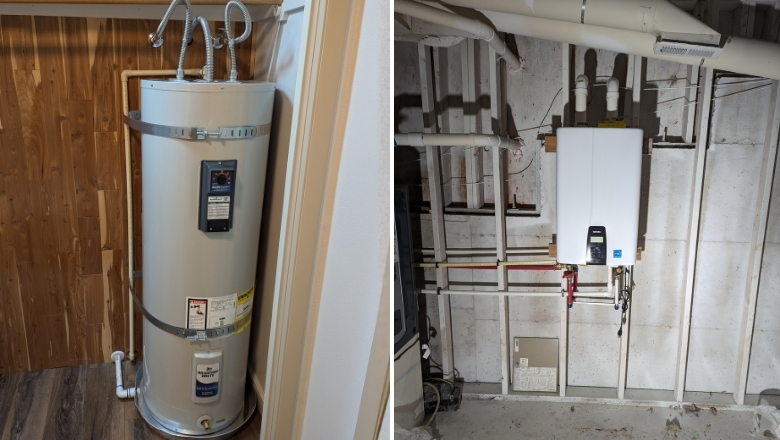
The fundamental difference between these two systems isn’t really about technology; it’s about when the water is heated. The tank heats a fixed volume in advance and reheats it around the clock. A tankless unit heats water only when someone opens a hot water tap.
| Feature | Tank Water Heater | Tankless Water Heater |
| Hot Water Supply | Fixed volume, can run out | Continuous hot water while flow demand is met |
| Standby Energy Loss | Ongoing, even when idle | Near zero, no stored water to reheat |
| Typical Lifespan | 10–15 years | 20+ years |
| Space Requirement | Large floor footprint | Compact, wall-mounted |
| Maintenance Needs | Sediment buildup flushing | Annual maintenance and mineral descaling |
| Recovery After Heavy Use | Slower, tank must reheat | Instant, but flow-rate dependent |
About a quarter of the energy used by tank water heaters is to keep hot water hot that no one is using yet. That ongoing loss is known as standby heat loss, and it’s the biggest efficiency gap between the two systems. It’s not in your utility bill, but it’s there for every hour the unit is plugged in or attached to gas.
The Cold Water Sandwich Most Buyers Never Hear About
Here’s something rarely mentioned in comparison articles: tankless systems can produce a strange, temporary blast of cold water in the middle of an otherwise warm shower, a quirk plumbers call the “cold water sandwich.” This is because a tankless unit will turn its burner off the instant water flow briefly stops, then must reheat the exchanger when flow resumes, sending a brief pocket of unheated water through the line in between.
This is not a defect and does not indicate a failing unit. But it does mean that sizing and installation are more important with tankless systems than most buyers realize. A unit that’s undersized for your family’s hot water usage, or one installed with the wrong gas line diameter, will experience this more often and more noticeably.
It Depends on Your Home
This isn’t about the objectively better option; it’s about which one fits the way your household actually works. The four factors below tend to make or break the decision:
1. Your Household Size
One person or a family of five uses a water heater, and their needs are not the same. Bigger homes tend to have multiple hot water draws, showers, laundry, and dishwashing happening all at the same time – requiring a system that can keep up with real household water demand, not just average use.
2. Your Daily Hot Water Usage
Homes with staggered, moderate usage rarely strain a tank system. Homes with simultaneous, high-volume draws are where tankless systems earn their reputation, since they’re rated according to how many gallons they can heat each minute instead of how much water they can hold.
3. Your Budget
The tankless water heater cost is usually greater upfront, particularly if gas line upsizing or new venting is necessary. The tank system typically costs less to install, but it has higher utility bills and a shorter life span.
4. How Long Do You Plan to Stay in Your Home
If you intend to stay put for a decade or more, the long-term savings of a tankless unit generally outweigh the higher initial investment. If a move is on the horizon, the lower installation costs of a tank may make more sense.
Cost vs. Long-Term Savings
Upfront pricing tells half the story. U.S. Department of Energy research has found that tankless water heaters can run roughly 24 to 34 percent more efficiently than storage tank models in homes using moderate daily hot water, with the efficiency gap widening even further in high-usage households.
That efficiency gain adds up over the years. A tankless unit typically lasts for twenty years or more, almost twice the lifespan of a traditional tank, because it doesn’t have to reheat standing water all day, every day. Over that same twenty-year window, a tank system will most likely need a complete replacement, while a well-maintained tankless unit is often just getting started. That single fact reshapes the entire cost comparison, since two full water heater replacement cycles cost significantly more than one, even before factoring in the energy savings along the way.
When to Call a Professional
Certain warning signs shouldn’t wait for a scheduled inspection. If you notice any of the following, it’s time to bring in a residential plumbing professional:
- The unit is over ten years old and heats less consistently.
- Water coming out rusty, cloudy, or discolored.
- Noticeable temperature swings during a single shower.
- Unusual popping, rumbling, or knocking sounds from the tank.
- Rising utility bills with no other explanation.
- Visible corrosion, moisture, or pooling near the base of the unit.
Waiting on any of these almost always ends the same way: a sudden failure rather than a planned water heater installation. What could have been a controlled, budgeted upgrade becomes an emergency call, often at the worst possible time.
Making the Right Call for Your Water Heater
Comparing tank and tankless water heaters ultimately comes down to how your household uses hot water, how long you plan to stay in your home, and how much weight you place on long-term energy savings versus lower upfront installation costs. Tankless systems generally win on water heater efficiency, lifespan, and home energy efficiency, while tank systems remain the more budget-friendly option at the point of purchase.
We’ve spent more than 23 years helping homeowners across Snohomish, Skagit, and Island counties make this exact call, and we approach every water heating system the same way: by assessing actual usage first, not just replacing what’s already there. Whether your household needs a straightforward tank swap or a full transition to an on-demand system, our team evaluates your gas lines, venting, and daily hot water usage before making any recommendations, including for homeowners in Burlington, Marysville, Stanwood, and Mount Vernon who reach out to us directly.
If your water heater is aging, acting up, or you’re simply ready to stop losing money to standby heat loss, don’t wait for a failure to force the decision. Call Alpine Plumbing at (360) 939-2424 and we’ll help you choose the system that actually fits your home.
